

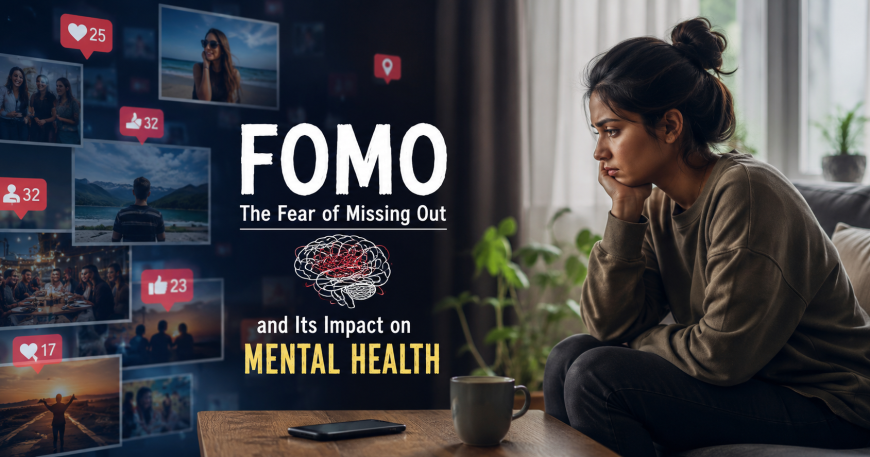
FOMO and Mental Health: 5 Alarming Ways the Fear of Missing Out Harms You
FOMO and mental health are more deeply connected than most people realise. The Fear of Missing Out — that persistent, unsettling sense that others are living better, experiencing more, and being somewhere more exciting than you — has existed as a human experience for generations. But in the era of social media, FOMO and mental health have become inseparable concerns, with digital platforms amplifying the fear to a level of intensity that previous generations never encountered.
At Hapinus Care, our counseling team works with individuals across Kerala who are experiencing the psychological consequences of FOMO and mental health deterioration — often without recognising that the two are connected. This blog outlines five alarming ways FOMO and mental health intersect, and what you can do about it.
What Is FOMO?
FOMO — the Fear of Missing Out — is the anxiety-provoking sense that others are having rewarding experiences from which you are absent. It is characterised by a desire to stay continuously connected with what others are doing, an urge to be included, and a persistent feeling of inadequacy when you perceive yourself as missing out on something valuable.
Research on FOMO and social media anxiety confirms that FOMO is directly associated with lower life satisfaction, increased anxiety disorder symptoms, and greater social media engagement — creating a self-reinforcing cycle that is difficult to break without deliberate intervention.
5 Alarming Ways FOMO and Mental Health Are Connected
1. FOMO and Mental Health: The Anxiety Loop
One of the most direct connections between FOMO is the anxiety loop it creates. Checking social media to reduce FOMO temporarily relieves the discomfort — but simultaneously exposes you to more content that triggers FOMO and mental health deterioration. The relief is momentary. The anxiety returns, often stronger than before.
This loop operates on the same neurological principles as other anxiety-maintaining behaviours — short-term relief that reinforces the problem long-term. The more you check to soothe FOMO anxiety, the more dependent on checking you become.
2. FOMO and Mental Health: Chronic Social Comparison
FOMO and mental health deterioration are deeply linked through the mechanism of social comparison. Social media presents a curated highlight reel of others’ lives — the celebrations, achievements, travels, and relationships — without the ordinary, difficult, or mundane moments in between.
When FOMO collide through chronic social comparison, the result is a persistent and distorted perception that your life is less than it should be. This perception — sustained over weeks and months — erodes self-esteem, reduces life satisfaction, and increases vulnerability to depression.
3. FOMO and Mental Health: Disrupted Sleep
FOMO and mental health are also connected through sleep disruption. The fear of missing something important keeps individuals checking their phones late into the night — a pattern known as revenge bedtime procrastination driven by FOMO anxiety.
The blue light exposure, the emotional activation from social content, and the simple habit of screen engagement before sleep all disrupt melatonin production and sleep architecture. Chronic sleep disruption then compounds FOMO decline — creating exhaustion that makes emotional regulation, self-esteem, and resilience all significantly harder.
4. FOMO and Mental Health: Reduced Presence and Enjoyment
One of the most paradoxical consequences of FOMO anxiety is reduced enjoyment of actual experiences. People experiencing FOMO distress often report that even while doing something pleasurable — attending an event, spending time with friends, going on holiday — they are simultaneously monitoring what else might be happening elsewhere.
This split attention prevents full presence. And reduced presence means reduced enjoyment — which in turn reinforces the sense that this experience is insufficient and something better must be elsewhere. FOMO and mental health interact to make every present moment feel inadequate.
5. FOMO and Mental Health: Emotional Burnout
The sustained activation required to monitor, compare, and respond to the social landscape is exhausting. FOMO burnout is increasingly common — particularly among young adults and adolescents who have grown up in environments where digital social monitoring is continuous and expected.
Emotional burnout from FOMO and mental health strain manifests as chronic fatigue, emotional numbness, reduced motivation, and a growing sense of meaninglessness — all of which are warning signs that the individual’s psychological resources have been depleted.
Breaking the FOMO and Mental Health Cycle
Understanding the connection between FOMO is the first step. Practical strategies include:
Intentional social media use — setting specific times for checking rather than continuous monitoring, which interrupts the anxiety loop of FOMO.
Digital boundaries — designated phone-free periods, particularly in the evening, that allow the nervous system to disengage from the constant social monitoring that drives FOMO anxiety.
Mindfulness and present-moment anchoring — practices that train attention to engage fully with what is actually happening rather than what might be happening elsewhere.
Values clarification — identifying what genuinely matters to you independent of what others are doing, which reduces the power of comparison-driven FOMO and mental health distress.
Professional counseling — when FOMO and mental health decline is persistent, significantly affecting sleep, relationships, or daily functioning, professional psychological support is the most effective intervention.
When to Seek Help for FOMO and Mental Health Concerns
Professional support is appropriate when FOMO and mental health distress is:
- Significantly disrupting sleep most nights
- Causing persistent low mood or anxiety that does not respond to self-help strategies
- Driving compulsive social media checking that you feel unable to control
- Producing chronic feelings of inadequacy, envy, or meaninglessness
- Affecting your ability to be present in relationships or activities you previously valued
At Hapinus Care, our counselors provide confidential support for FOMO and mental health concerns across centers in Trivandrum, Kochi, Calicut, Kannur, and Kottayam. Online counseling in English and Malayalam is also available.
Call 9207 07 51 51 or book through WhatsApp.

