

Smartphone Dependence: 5 Alarming Signs Your Relationship With Your Phone Has Become a Problem
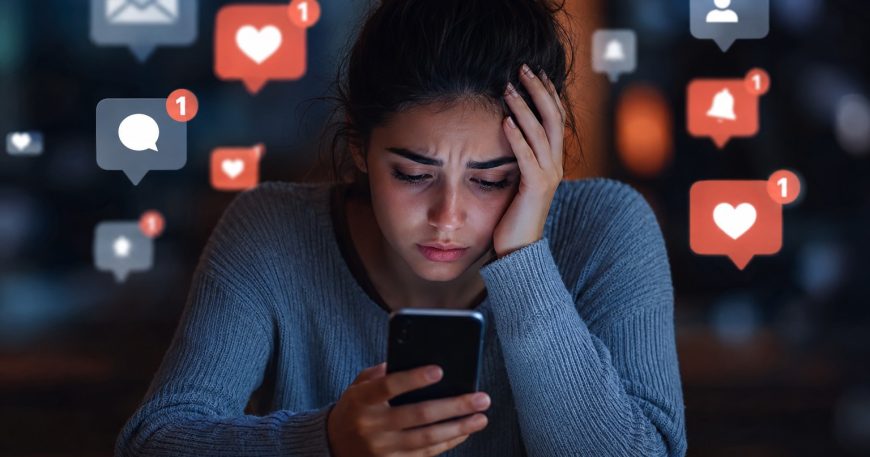
Smartphone dependence is one of the fastest-growing and most underrecognised mental health concerns of the digital age. The term describes a pattern in which an individual’s relationship with their smartphone has shifted from functional tool to emotional necessity — where the absence of the phone triggers anxiety, restlessness, or genuine distress.
While smartphone dependence is not yet classified as a standalone mental health disorder, the psychological patterns it produces are clinically meaningful and increasingly prevalent — particularly among young adults in Kerala and across India.
Smartphones have genuinely transformed modern life for the better. They allow us to communicate instantly, navigate unfamiliar cities, work remotely, access healthcare information, manage finances, and stay connected to the people we care about. The problem is not the technology itself. The problem is when smartphone dependence means a person can no longer tolerate the absence of the device — even briefly — without experiencing significant emotional dysregulation.
At Hapinus Care, our psychological counseling team works with individuals whose smartphone dependence is affecting their sleep, concentration, relationships, and ability to manage difficult emotions. This blog outlines what smartphone dependence actually involves, five alarming signs to watch for, and what effective support looks like.
What Is Smartphone Dependence?
Smartphone dependence describes a pattern of compulsive, emotionally driven smartphone use in which the device has become a primary mechanism for managing mood, anxiety, boredom, and social connection.
How Smartphone Dependence Develops
Smartphone dependence does not develop suddenly. It builds gradually through the interaction of two forces — the human brain’s sensitivity to reward, and social media platforms specifically engineered to exploit it.
Every notification, like, and comment triggers a small dopamine release. Over time, the brain begins to anticipate this reward and to crave it — generating the impulse to check the phone even when no notification has arrived. This is the neurological foundation of smartphone dependence: a reward-seeking loop that runs below conscious intention.
The condition is often referred to as nomophobia — from “no-mobile-phone phobia” — describing the anxiety experienced when the phone becomes inaccessible. Whether the label is nomophobia or smartphone dependence, the clinical picture is the same: a person whose emotional regulation has become contingent on device access.
Research on smartphone use and compulsive behaviour patterns confirms that these patterns activate the same automatic, non-conscious neural pathways as other recognised behavioural dependencies — making smartphone dependence genuinely difficult to interrupt through willpower alone.
5 Alarming Signs of Smartphone Dependence
1. Smartphone Dependence Sign: Anxiety When the Phone Is Out of Reach
The most consistent indicator of smartphone dependence is disproportionate anxiety when the phone is unavailable — when the battery is low, when it is left in another room, or when there is no signal.
What This Anxiety Reveals
This is not simple practical concern about staying contactable. It is the anxiety of an emotional regulator being withdrawn. When the absence of an object produces anxiety, that object has become a coping mechanism — and its removal exposes the emotional states it was suppressing.
Carrying a charger everywhere, being unable to leave the house without a fully charged phone, or checking the battery percentage repeatedly are behavioural expressions of this anxiety — and reliable indicators of smartphone dependence.
2. Smartphone Dependence Sign: Compulsive Checking Without a Trigger
A defining feature of smartphone dependence is the experience of checking the phone reflexively — without any notification, without any specific question, and often immediately after having just checked it.
The Loss of Intentional Use
When phone checking becomes automatic rather than intentional — a reflex to boredom, discomfort, or an unoccupied moment — smartphone dependence has taken hold. The user is no longer choosing to engage with the device. The device is pulling their attention involuntarily.
If you find yourself reaching for your phone in the middle of a conversation, during a meal, or seconds after putting it down, this compulsive quality is worth taking seriously.
3. Smartphone Dependence Sign: Emotional Distress When Connectivity Is Lost
Poor signal. Airplane mode. A day without internet. For most people, these are mild inconveniences. For individuals with significant smartphone, the same situations can produce genuine distress — irritability, restlessness, difficulty concentrating, or a sense of unease that is difficult to name or explain.
The Emotional Driver Underneath
This disproportionate response to disconnection reveals that the smartphone has been functioning as emotional management — containing anxiety, loneliness, and boredom that surface immediately when the device is unavailable.
Anxiety disorder and smartphone frequently co-occur for exactly this reason. The phone becomes a coping mechanism for anxiety — and its absence removes the coping mechanism while the anxiety remains.
4. Smartphone Dependence Sign: Sleep Disruption From Compulsive Late-Night Use
Smartphone dependence almost always affects sleep. The pattern is predictable — the phone is checked long past a reasonable bedtime, is the last thing engaged with before attempting to sleep, and is the first thing reached for upon waking, often before getting out of bed.
The Cost of This Pattern
Blue light suppresses melatonin. Emotionally activating content — social media, news, messaging — keeps the nervous system aroused when it should be winding down. And the conditioned habit of phone-as-night-companion means that falling asleep without the device begins to feel genuinely uncomfortable.
Chronic sleep disruption driven by smartphone significantly increases anxiety, reduces emotional regulation capacity, impairs concentration, and compounds every psychological vulnerability that smartphone both reflects and sustains.
5. Smartphone Dependence Sign: Reduced Presence in Real-World Relationships
One of the most socially significant consequences of dependence is its erosion of real-world presence. Checking the phone during conversations, meals, family time, or moments that deserve full attention — these patterns reduce the quality of connection that dependence is often, paradoxically, seeking to supplement.
The FOMO Connection
The fear of missing out (FOMO) and dependence are deeply intertwined — both driven by anxiety about disconnection, and both producing the very disconnection they seek to avoid. The phone promises connection while its compulsive use consistently reduces the depth and quality of real-world connection.
Building a Healthier Relationship With Technology
Practical Steps That Reduce Smartphone Dependence
Managing smartphone dependence does not require abandoning your phone. It requires becoming intentional rather than automatic about how and when you use it.
- Track your actual usage — screen time data is often genuinely surprising and provides the awareness that motivates change
- Create phone-free zones and times — no phones during meals, in the bedroom, or for the first 30 minutes after waking
- Reduce notifications — every non-essential notification is a micro-reward that reinforces smartphone; turning them off reduces compulsive checking significantly
- Have a specific replacement activity — when the urge to check arises, have a pre-decided alternative: a short walk, a minute of breathing, a page of a book
- Pause before opening any app — one breath and one question: what am I actually looking for right now?
When Smartphone Dependence Requires Professional Support
Self-directed strategies are effective for many people — and they have real limits. If smartphone is significantly disrupting sleep, affecting professional or academic performance, straining relationships, or producing anxiety that you cannot manage alone, professional psychological support is the most effective next step.
At Hapinus Care, our psychological counseling team helps individuals understand the emotional needs driving dependence — anxiety, loneliness, difficulty with unstructured time, or low mood — and develops sustainable, personalised strategies for a genuinely healthier relationship with technology.
Support is available in person across centers in Trivandrum, Kochi, Calicut, Kannur, and Kottayam, and online in English and Malayalam.
No referral is needed. Call 9207 07 51 51 or book through WhatsApp.

