

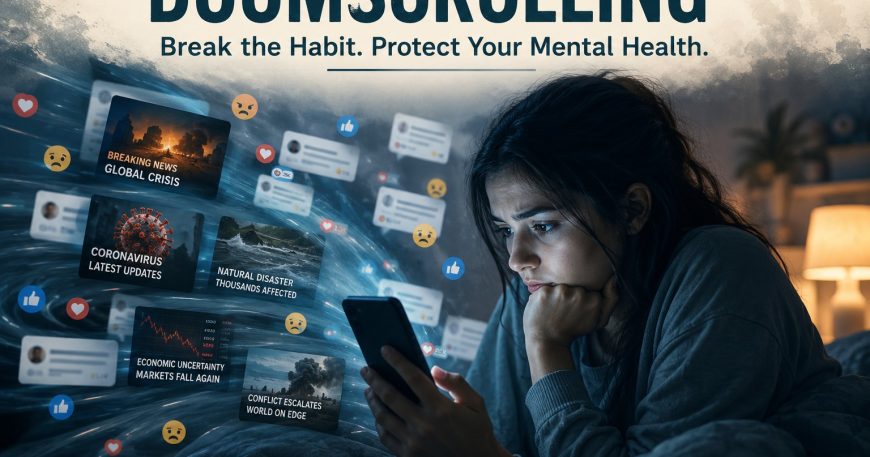
Doomscrolling: 5 Signs, Effects on Mental Health and How to Break the Habit
Doomscrolling is one of the most common — and most quietly damaging — digital habits of the modern age. In today’s information-saturated world, staying informed is easier than ever. But for millions of people, what starts as checking a single headline turns into hours of compulsive scrolling through disaster stories, conflict updates, economic fears, and health crises — long past the point where it serves any useful purpose.
At Hapinus Care, our psychological counseling team regularly works with individuals whose anxiety, sleep difficulties, and emotional exhaustion are directly linked to doomscrolling. Understanding what drives it, how to recognise it, and how to break the cycle is one of the most practical mental health skills available in 2026.
What Is Doomscrolling and Why Does It Happen?
Doomscrolling refers to the compulsive consumption of negative or distressing online content — continuing to scroll despite feeling anxious, overwhelmed, or emotionally drained. It became widely recognised during the COVID-19 pandemic, but it continues to intensify as news cycles grow faster and social media algorithms become more sophisticated.
The Psychological Drivers Behind Doomscrolling
Doomscrolling is not simply a failure of willpower. It is driven by real psychological mechanisms that are worth understanding.
Negativity Bias
The human brain is evolutionarily primed to pay more attention to threatening information than to neutral or positive content. This survival mechanism — the negativity bias — means alarming headlines capture attention more powerfully than good news, making doomscrolling feel compulsive even when it is distressing.
Fear of Missing Important Information
Many people doomscroll because they fear that not checking will mean missing something critical. This fear of being uninformed creates a checking loop that is difficult to interrupt even when the information being consumed is generating more anxiety than clarity.
Algorithm Design
Social media and news platforms are designed to maximise engagement. Research on problematic news consumption and mental health confirms that digital algorithms amplify emotionally charged and distressing content — making doomscrolling not just a personal habit but a structurally engineered behaviour.
Uncertainty and Anxiety
During periods of stress, people seek information hoping it will reduce their anxiety. With doomscrolling, the opposite occurs — each piece of distressing news generates more uncertainty, which generates more searching, which generates more distress.
5 Signs You Are Doomscrolling
Recognising doomscrolling in yourself is not always straightforward — it often masquerades as staying informed. Here are five signs the habit has crossed into harmful territory.
1. You Scroll Without a Clear Purpose
You open your phone with no specific question to answer — and find yourself absorbed in upsetting content twenty minutes later without having intended to spend more than thirty seconds.
2. You Feel Worse After Every Session
Doomscrolling consistently leaves you feeling more anxious, hopeless, or emotionally drained than before you started — yet you continue anyway.
3. You Check First Thing in the Morning and Last Thing at Night
If your phone is the first thing you reach for after waking and the last thing you look at before sleeping, scrolling has become a reflexive habit rather than an intentional choice.
4. You Have Difficulty Stopping
You tell yourself “one more article” or “just a few more minutes” — and an hour passes. The inability to stop despite intending to is one of the clearest markers of compulsive scrolling.
5. Your Mood and Functioning Are Being Affected
You feel more pessimistic about the future, less able to concentrate, more irritable with the people around you, or chronically fatigued — and these patterns correlate directly with your scrolling sessions.
How Doomscrolling Affects Mental Health
The mental health consequences of chronic scrolling are measurable, significant, and worth taking seriously.
Doomscrolling and Anxiety
Constant exposure to alarming headlines keeps the brain in a sustained state of low-level threat activation — triggering the sympathetic nervous system and maintaining an anxious baseline. For individuals already dealing with anxiety disorder, scrolling significantly worsens symptom severity and makes recovery harder.
Doomscrolling and Sleep
Doomscrolling before bed produces a dual disruption to sleep. Blue light exposure from screens suppresses melatonin production. And the emotional activation from distressing content keeps the nervous system aroused long after the phone is put down — making it harder to fall asleep, stay asleep, and reach the restorative deep sleep stages the brain needs.
Doomscrolling and Emotional Exhaustion
Reading about tragedies, conflicts, and crises continuously depletes the emotional resources needed to manage daily life. This emotional exhaustion is distinct from ordinary tiredness — it is a saturation of the nervous system that reduces empathy, motivation, and the capacity for genuine connection.
Doomscrolling and Productivity
Frequent checking of news and social media fragments attention throughout the working day. The cognitive switching cost of each interruption is cumulative — scrolling across a day significantly reduces the capacity for deep, focused work.
How to Break the Doomscrolling Habit: 5 Proven Strategies
1. Set Specific Times for News Consumption
Instead of checking continuously, designate one or two fixed times per day for news — and close all news and social media outside those windows. This contains doomscrolling without requiring complete avoidance.
2. Curate Your Digital Environment
Unfollow accounts and pages that consistently post sensational or fear-inducing content. Disable push notifications for news apps. Reduce the number of news sources you follow to two or three reliable ones. Making the environment less conducive to doomscrolling reduces the cognitive effort required to resist it.
3. Create Phone-Free Zones and Times
No phones at the dinner table. No phones in the bedroom. No phones for the first thirty minutes after waking. These small structural changes interrupt the reflexive quality of doomscrolling by removing the opportunity for it in the environments where it is most likely to begin.
4. Replace Scrolling With a Specific Alternative Activity
When the urge to scroll arises, have a specific replacement already decided — a brief walk, five minutes of deep breathing, a conversation with someone nearby, or a page of a book. Vague intentions to “do something else” are far less effective than a concrete, pre-chosen alternative.
5. Practice Mindful Technology Use
Before opening any news or social media platform, pause for one breath and ask: what am I looking for right now, and why? This simple moment of intention interrupts the automaticity of doomscrolling and restores a degree of conscious choice over the behaviour.
When Doomscrolling Is a Symptom of Something Deeper
Sometimes doomscrolling is not the primary problem — it is a coping mechanism for an underlying mental health difficulty. If you notice that:
- Anxiety is present most days regardless of news consumption
- Sleep has been significantly disrupted for more than two weeks
- You are using doomscrolling to avoid difficult emotions rather than stay informed
- Persistent low mood or hopelessness is present beyond what news content explains
— then speaking with a qualified psychologist is the most important next step. Professional support through psychological counseling helps identify the emotional drivers behind compulsive digital behaviour and builds sustainable, personalised strategies for managing both the habit and what underlies it.
Building a Healthier Relationship With Information
Doomscrolling begins with a legitimate desire to stay informed — and becomes a problem when that desire is hijacked by anxiety, algorithm design, and the brain’s own negativity bias. The goal is not to disengage from the world but to engage with it on your own terms, at times you choose, in ways that leave you more informed rather than more afraid.
At Hapinus Care, our team supports individuals across Trivandrum, Kochi, Calicut, Kannur, and Kottayam in breaking digital habits that are affecting their mental health — alongside professional support for anxiety, stress, and emotional exhaustion.
Online counseling in English and Malayalam is also available.
No referral is needed. Call 9207 07 51 51 or book through WhatsApp.

