

Top Psychology Clinic in Kerala: 5 Powerful Insights on AI and Young Minds
As Kerala’s top psychology clinic, Hapinus Care is at the forefront of understanding how artificial intelligence is reshaping the mental landscape of young people. AI is no longer a distant concept — it is woven into the daily lives of children and adolescents through social media algorithms, generative AI tools, gaming, and recommendation systems that learn, adapt, and respond to their behaviour in real time.
The psychological implications of this are significant — and largely uncharted. This blog offers five powerful insights from our adolescent counseling team on how AI is affecting young minds in Kerala today.
The Context: AI and Young Minds in Kerala
Kerala’s young people are among the most digitally connected in India. High smartphone penetration, strong internet infrastructure, and a culture that values education and achievement have created a generation that is deeply immersed in technology from an early age.
Research on technology use and youth mental health consistently shows that while technology offers genuine benefits — access to information, creative expression, social connection — unsupervised and excessive engagement with AI-driven platforms creates measurable psychological risks for developing minds.
As Kerala’s top psychology clinic, Hapinus Care works with young people and families navigating these risks every day.
5 Powerful Insights from Top Psychology Clinic in Kerala on AI and Young Minds
1. AI Algorithms Are Designed to Maximise Engagement — Not Wellbeing
The most important thing parents and young people in Kerala need to understand is this — AI recommendation systems on social media and entertainment platforms are not designed to make young people happy or healthy. They are designed to maximise time on platform.
This means the algorithm learns what content produces the strongest emotional reaction — anxiety, outrage, excitement, comparison — and serves more of it. For a developing adolescent brain, this creates a feedback loop of emotional activation that is difficult to interrupt and psychologically costly over time.
As Kerala’s top psychology clinic, we see the consequences of this regularly — young people who feel compelled to scroll even when they know it is making them feel worse.
2. AI Is Changing How Young People Relate to Uncertainty
One of the developmental tasks of adolescence is learning to tolerate uncertainty — not knowing, being wrong, sitting with ambiguity. This capacity is foundational to resilience, creativity, and emotional maturity.
AI tools that instantly generate answers, complete tasks, and resolve uncertainty are subtly eroding this developmental process. Young people who rely heavily on AI for cognitive tasks may be bypassing the productive struggle that builds mental strength.
At Hapinus Care — top psychology clinic in Kerala— our counselors are beginning to address this directly in sessions with adolescents who report difficulty concentrating, tolerating boredom, or persisting through challenges without immediate digital support.
3. AI-Generated Content Is Distorting Body Image and Social Comparison
AI image generation and editing tools have made it easier than ever to create and consume visually idealised content. For young people already navigating the psychological minefield of body image and social comparison, the proliferation of AI-enhanced imagery creates an impossible standard.
The problem is not that young people know these images are edited — many do. The problem is that the emotional brain responds to images faster than the rational brain can apply critical thinking. The felt sense of inadequacy accumulates regardless of intellectual awareness.
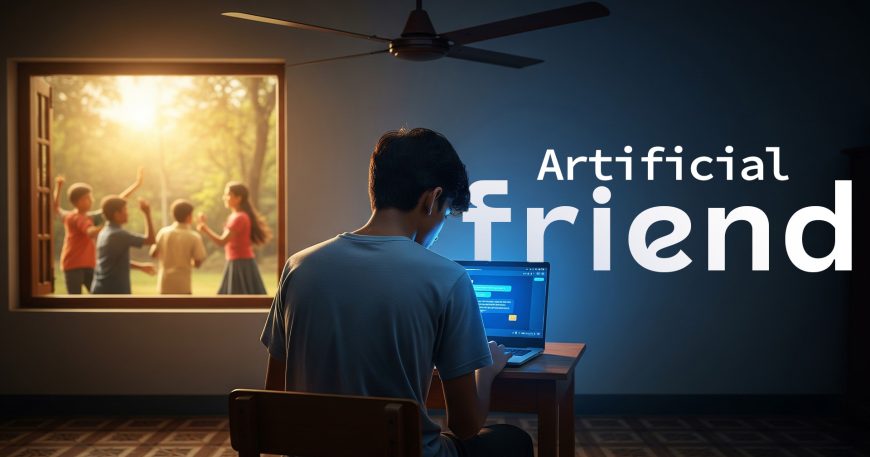
4. AI Companions and Chatbots Are Not a Substitute for Human Connection
A growing number of young people in Kerala are using AI chatbots as emotional outlets — sharing worries, seeking advice, and processing experiences through these tools. While this is understandable — AI is available, non-judgmental, and never tired — it carries genuine psychological risk.
Human connection involves attunement, imperfection, repair, and genuine mutual recognition. AI cannot provide any of these. Over-reliance on AI for emotional support may actually reduce young people’s capacity for and comfort with authentic human relationships — the very relationships that are most protective for mental health.
As Kerala’s top psychology clinic, Hapinus Care strongly encourages parents to be aware of their children’s use of AI companionship tools and to ensure that human support — from family, peers, and where needed, professional counselors — remains central.
5. AI Literacy Is Now a Mental Health Skill
The most effective response to the psychological risks of AI is not restriction alone — it is education. Young people who understand how AI works, what it is designed to do, and how it influences their emotions and behaviour are significantly better equipped to use it consciously rather than compulsively.
At Hapinus Care — top psychology clinic in Kerala — we now incorporate AI literacy into our psychoeducation work with adolescents. Understanding that an algorithm is designed to trigger emotional reactions is one of the most practical protective factors a young person can have.
What Parents Can Do
- Have open, non-judgmental conversations about what your child is consuming online
- Set boundaries around screen time — particularly before bed and during meals
- Model conscious technology use yourself
- Watch for signs that digital use is affecting sleep, mood, concentration, or relationships
- Seek professional support early if you notice significant behavioural or emotional changes
Hapinus Care —Top Psychology Clinic in Kerala for Young People
Hapinus Care works with children, adolescents, and families across Trivandrum, Kochi, Calicut, Kannur, and Kottayam. Our team includes specialists in child and adolescent mental health who are equipped to address both traditional psychological concerns and the emerging challenges of digital life.
Online counseling in English and Malayalam is also available — making Kerala’s top psychology clinic accessible from anywhere in the state.
Call 9207 07 51 51 or book through WhatsApp to schedule an appointment.

