

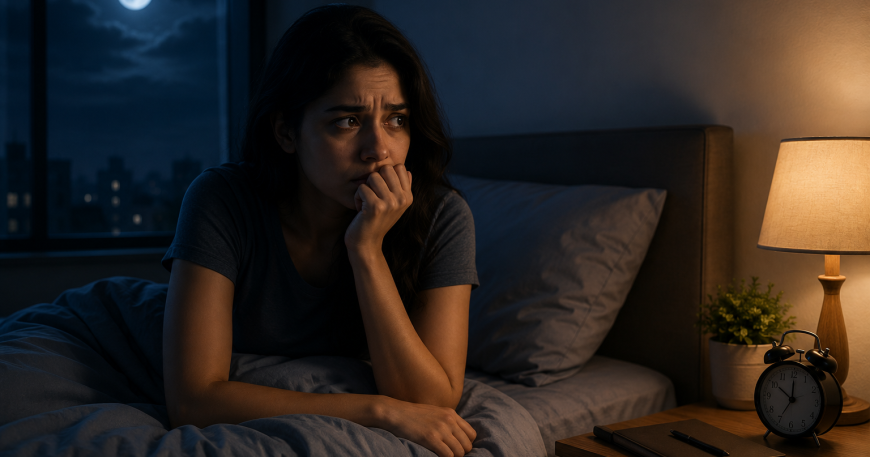
Anxiety at Night: 5 Causes, Symptoms and Proven Ways to Calm Your Mind
Anxiety at night is one of the most common and most disruptive mental health experiences in modern life. After a demanding day, most people look forward to rest. But for many individuals, bedtime is not the quietest part of the day — it is the loudest.
The moment the lights go out and the external world becomes still, the internal world accelerates. Thoughts about work, relationships, finances, health, or the future suddenly feel overwhelming. Sleep, which should come naturally, becomes something to fight for.
If anxiety is a regular part of your experience, you are not alone — and you are not without options. This blog outlines five key causes of anxiety, its most common symptoms, and proven strategies to calm your mind before sleep.
Why Anxiety at Night Feels So Much Worse
Daytime Distractions Disappear
One of the most significant reasons anxiety intensifies is the disappearance of daytime distractions. Throughout the day, work tasks, conversations, physical movement, and external demands occupy the brain’s attentional resources. Anxious thoughts have less room to expand when the mind is actively engaged.
At night, that engagement disappears. In the resulting quiet, anxiety fills the space that activity was previously occupying — and does so with significantly less competition.
Mental and Emotional Fatigue
After a full day of decisions, problem-solving, and emotional management, the brain becomes genuinely fatigued. Emotional regulation is one of the most energy-intensive cognitive functions — and when those resources are depleted, the capacity to contain anxious thoughts and put them in perspective is significantly reduced.
This is why anxiety often feels disproportionate to whatever is actually being worried about. The concern may be real. The fatigue amplifying it is equally real.
5 Key Causes of Anxiety at Night
1. Anxiety at Night Caused by Unprocessed Daily Stress
When the nervous system has been in a heightened state throughout the day — responding to deadlines, interpersonal friction, or unresolved decisions — it does not automatically de-escalate at bedtime. The biological stress response continues until it is actively interrupted.
Research on anxiety and nocturnal wakefulness confirms that elevated cortisol and sympathetic nervous system activation during the day directly predict sleep disruption and anxiety at night — particularly when no deliberate wind-down routine exists.
2. Anxiety at Night Worsened by Screen Use Before Bed
Scrolling through news, social media, or emotionally activating content immediately before sleep is one of the most consistent environmental triggers for anxiety. The blue light exposure suppresses melatonin production. But beyond the physiological mechanism, the emotional content of late-night screens keeps the nervous system aroused when it most needs to deactivate.
3. Anxiety at Night Related to Caffeine and Stimulant Use
Caffeine has a half-life of approximately five to six hours. A coffee consumed at 3pm still has 50% of its stimulant effect active at 8pm — directly contributing to anxiety through sustained sympathetic nervous system activation.
Many people who experience significant anxiety at night are unknowingly self-medicating with stimulants that compound the problem.
4. Anxiety at Night as a Feature of an Underlying Anxiety Disorder
For some individuals, anxiety at night is not a situational response — it is a symptom of an underlying anxiety disorder that intensifies at night when distractions are removed. Generalised Anxiety Disorder, Panic Disorder, and Health Anxiety all commonly produce intensified nocturnal symptoms.
When anxiety at night is persistent, occurs multiple times per week, and is significantly affecting sleep quality, professional assessment is the most important next step.
5. Anxiety at Night Triggered by Rumination
Rumination — the repetitive replaying of past events, conversations, and perceived failures — is one of the most common forms of anxiety at night. The quiet of bedtime creates the conditions in which rumination expands, pulling attention away from the present moment and into an internal loop that generates distress without resolution.
Common Symptoms of Anxiety at Night
Anxiety at night affects people physically, emotionally, and cognitively. Recognising the specific symptoms helps distinguish anxiety at night from ordinary tiredness.
Emotional and Cognitive Symptoms
- Racing thoughts that seem impossible to stop
- Excessive worry about future events, particularly those outside your control
- Replay of the day’s events and conversations
- Fear of not getting enough sleep — which itself becomes a source of anxiety at night
- Emotional sensitivity and irritability
Physical Symptoms
- Rapid heartbeat or heart palpitations
- Chest tightness or shallow breathing
- Muscle tension — particularly in the jaw, neck, and shoulders
- Stomach discomfort or nausea
- Sweating despite a comfortable room temperature
- Repeated waking during the night after initially falling asleep
For some individuals, anxiety at night escalates into nocturnal panic attacks — brief but intensely distressing episodes of acute fear, physical arousal, and a sense of imminent danger that can be genuinely frightening even when no external threat is present.
5 Proven Ways to Calm Anxiety at Night
1. Build a Consistent Wind-Down Routine
The most consistently effective strategy for reducing anxiety at night is a deliberate transition ritual — a set of activities that signals to the nervous system that the demanding part of the day is complete.
Begin wind-down approximately 45 minutes before your target sleep time. Include activities that are calming rather than stimulating — reading physical print, gentle stretching, a warm bath or shower, herbal tea. The routine itself becomes the cue.
2. Use Box Breathing for Immediate Relief
When anxiety at night escalates acutely, box breathing directly activates the parasympathetic nervous system:
- Inhale for 4 counts
- Hold for 4 counts
- Exhale for 4 counts
- Hold for 4 counts
Repeat four to five cycles. This simple technique measurably reduces heart rate and cortisol within minutes — and requires no equipment, no training, and no waiting for an appointment.
3. Externalise Anxious Thoughts Through Journaling
Anxiety is frequently sustained by the mental effort of trying to hold and manage multiple concerns simultaneously. Writing them down — in a worry journal, a to-do list for tomorrow, or a brief emotional log — transfers that holding function from working memory to paper.
Many clients find that anxiety reduces significantly within a week of beginning a consistent evening journaling practice.
4. Limit Screens and Caffeine From 3pm Onwards
Reducing blue light exposure and stimulant intake in the hours before sleep removes two of the most modifiable contributors to anxiety. Set a specific caffeine cutoff time. Replace evening screen time with activities that allow the nervous system to gradually de-escalate.
5. Seek Professional Support When Anxiety at Night Is Persistent
Self-directed strategies are effective for many people — and they have real limits. When anxiety is occurring most nights, significantly disrupting sleep, or affecting daily functioning, professional psychological support is the most appropriate response.
Cognitive Behavioural Therapy for Insomnia (CBT-I) and CBT for anxiety disorder are both highly effective, evidence-based approaches specifically targeting the thought patterns and behavioural cycles that sustain anxiety. At Hapinus Care, our psychological counseling team works with individuals across Kerala dealing with anxiety — in person at our centers in Trivandrum, Kochi, Calicut, Kannur, and Kottayam, and online in English and Malayalam.
Anxiety at night does not have to be your normal. With the right strategies and support, restful nights are possible.
No referral is needed. Call 9207 07 51 51 or book through WhatsApp.

