

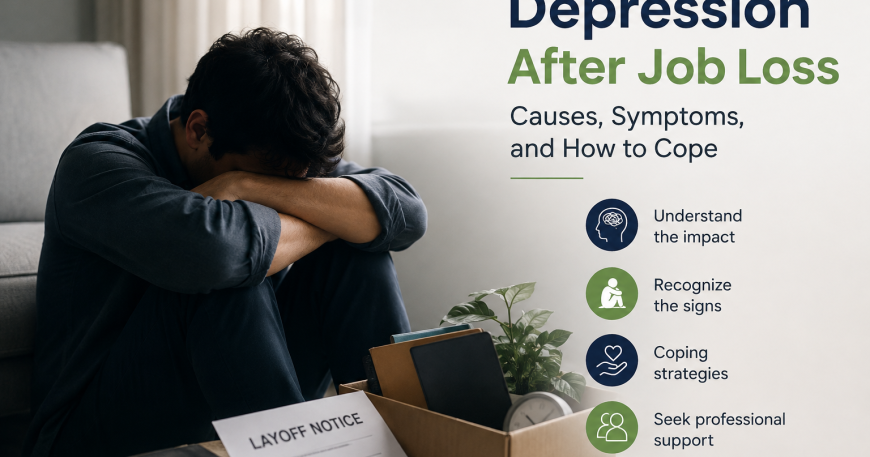
Depression After Job Loss: 5 Proven Ways to Recover and Rebuild
Depression after job loss is one of the most commonly experienced yet least talked-about mental health challenges facing working adults in Kerala today. Losing a job does far more than disrupt your income. It affects your sense of identity, your daily structure, your social world, and your belief in your own capabilities — and for many people, that combination of losses creates conditions in which depression takes hold.
If you have been struggling since losing your job — feeling persistently low, disconnected, or unable to see a clear path forward — this blog explains why depression after job loss happens, what it looks like, and five proven strategies for recovery.
Why Job Loss Causes Depression
Understanding why depression after job loss occurs helps remove the shame that often accompanies it.
Work Provides More Than Income
For most adults, employment fulfils several fundamental psychological needs simultaneously — structure, purpose, social connection, identity, and a sense of contribution. When a job ends, all of these needs are disrupted at once. That simultaneous loss is far more psychologically significant than losing an income alone.
The Identity Dimension
Many people define themselves partly through their professional role. Depression after job loss frequently involves a profound question about identity — “If I am not that role, who am I?” This is not self-pity. It is a legitimate psychological crisis that deserves professional support.
Financial Anxiety as a Sustained Stressor
Research on unemployment and mental health outcomes confirms that the financial uncertainty of unemployment is one of the strongest predictors of depressive symptoms — not because of money itself but because of the chronic cortisol elevation that sustained financial worry produces.
Social Comparison and Shame
In Kerala’s achievement-oriented culture, unemployment often carries social stigma. Many individuals dealing with depression after job loss withdraw from social contact to avoid conversations about their situation — and isolation reliably deepens depression rather than relieving it.
Signs That Depression After Job Loss May Be Developing
Sadness, frustration, and worry are normal initial responses to losing a job. Depression is different — it is a persistent, pervasive shift in functioning that does not ease with time or effort alone.
Emotional Signs
- Persistent low mood, hopelessness, or emotional emptiness for more than two weeks
- Loss of interest in activities that previously provided enjoyment
- Feelings of worthlessness or excessive self-blame that go beyond the job loss itself
- Tearfulness, irritability, or emotional flatness
Physical Signs
- Disrupted sleep — either insomnia or sleeping far more than usual
- Changes in appetite and weight without intention
- Persistent fatigue and low energy that rest does not relieve
- Headaches, muscle tension, or digestive discomfort without medical explanation
Behavioural Signs
- Withdrawal from family, friends, and social contact
- Difficulty starting or completing basic daily tasks
- Loss of motivation to search for work — not laziness, but genuine anhedonia
- Avoidance of situations that involve discussing employment or professional life
If several of these signs are present consistently for more than two weeks, depression after job loss has likely moved beyond normal adjustment and warrants professional support.
5 Proven Ways to Recover From Depression After Job Loss
1. Re-Establish a Daily Structure
The absence of work removes the external structure that most adults depend on for psychological stability. Depression after job loss deepens in structureless time. Creating a deliberate daily routine — consistent sleep and wake times, scheduled meals, planned job search blocks, physical movement, and time for rest — restores the neurological predictability the stressed nervous system needs.
Start small. One consistent anchor point — such as a morning walk at the same time each day — is enough to begin rebuilding a structure that gradually grows.
2. Challenge the Story You Are Telling Yourself
Depression after job loss is sustained in large part by cognitive distortions — automatic thoughts that interpret the job loss as evidence of fundamental personal failure. “I am not good enough,” “I will never recover from this,” “Others are moving forward and I am stuck.”
These thoughts feel true. They are not facts. They are the mind under stress making catastrophic interpretations of a circumstance that is frequently outside your control.
Identifying and gently questioning these thought patterns is one of the most effective evidence-based approaches to recovery from depression after job loss. A qualified psychologist can guide this process systematically through psychological counseling — making what is difficult to do alone significantly more manageable with professional support.
3. Protect and Prioritise Social Connection
The instinct during depression after job loss is often to withdraw — to avoid people who might ask about your situation, or to spare others the burden of your difficulties. This instinct consistently makes depression worse.
Even one genuine, unhurried conversation with a trusted person each day provides the social regulation that reduces cortisol and counters the isolation that depression feeds on. You do not need to discuss your job situation every time. The connection itself is what matters.
4. Address the Physical Dimension of Depression
Depression after job loss is not only psychological — it is physiological. The brain and body are in a state of sustained stress, and physical interventions that directly address this state are clinically significant.
- Movement — even 20 minutes of walking daily measurably reduces cortisol and increases the endorphins and BDNF that support mood and neuroplasticity
- Sleep hygiene — consistent sleep and wake times, phone-free wind-down, and limiting daytime napping restore the sleep architecture that depression disrupts
- Nutrition — reducing processed food and caffeine, and prioritising whole foods supports the gut-brain axis that directly affects neurochemical balance
These are not optional lifestyle tips. They are evidence-based components of recovery from depression after job loss.
5. Seek Professional Support Before It Becomes Entrenched
Perhaps the most important step in addressing depression after job loss is seeking professional support early — before the depression deepens, before the patterns become entrenched, and before the accumulating losses of confidence and motivation make recovery feel impossible.
At Hapinus Care, our depression treatment team works with individuals experiencing depression after job loss across centers in Trivandrum, Kochi, Calicut, Kannur, and Kottayam. Using Cognitive Behavioural Therapy, psychodynamic approaches, and integrated care, we help individuals understand what is driving their depression, develop practical recovery strategies, and rebuild the confidence and purpose that job loss has disrupted.
Online counseling in English and Malayalam is also available — making professional support accessible regardless of where you are in Kerala, or abroad.
When to Seek Help Immediately
If feelings of hopelessness become severe, if you are having thoughts of harming yourself, or if depression after job loss is significantly impairing your ability to function — please reach out to Hapinus Care immediately rather than waiting.
Your employment status does not define your worth. Depression after job loss is a real, clinical condition — and it responds to the right support.
No referral is needed. Call 9207 07 51 51 or book through WhatsApp.

