

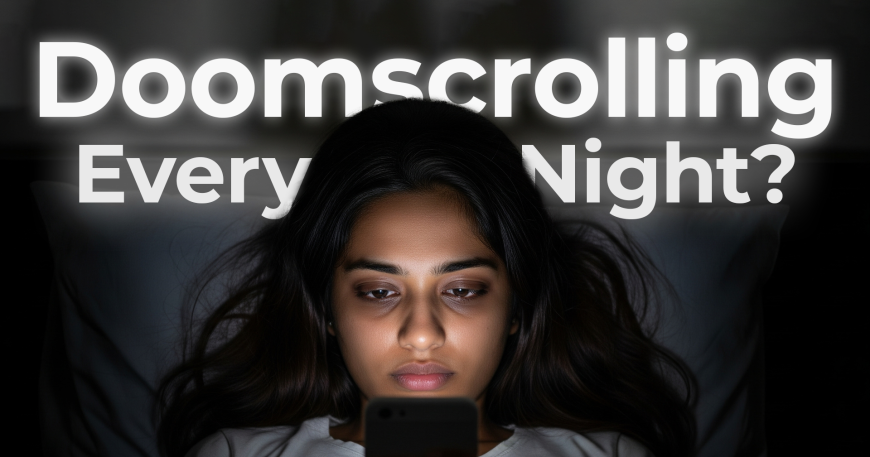
Revenge Bedtime Procrastination: 5 Alarming Signs and Proven Fixes
Revenge bedtime procrastination is one of the most quietly destructive habits affecting mental health in Kerala today — and most people who engage in it do not even know it has a name. It is the pattern of deliberately staying up late at night, not because you are not tired, but because nighttime feels like the only time that truly belongs to you.
At Hapinus Care, our psychology clinic in Kerala works with clients who describe this experience almost word for word — exhausted from the demands of the day, finally alone, finally free, finally in control of something — and completely unable to make themselves go to sleep.
This blog explains what revenge bedtime procrastination actually is, five alarming signs you are doing it, and proven fixes that work.
What Is Revenge Bedtime Procrastination?
Revenge bedtime procrastination is the act of sacrificing sleep for leisure time at night as a way of reclaiming personal autonomy after a day that felt controlled by external demands — work, family, responsibilities.
The word “revenge” is telling. It is not passive avoidance of sleep. It is an active, emotionally driven assertion of self — a late-night rebellion against a life that leaves too little room for the individual.
Research on sleep deprivation and mental health confirms that chronic sleep loss significantly increases vulnerability to anxiety, depression, emotional dysregulation, and cognitive impairment — making revenge bedtime procrastination a mental health concern as well as a sleep one.
5 Alarming Signs You Are Engaging in Revenge Bedtime Procrastination
1. You Are Tired But Cannot Make Yourself Stop Scrolling
The most common sign of revenge bedtime procrastination is the experience of being genuinely exhausted — aware that you should sleep — and yet being completely unable to close your phone or turn off the screen.
This is not laziness. It is a psychological need for autonomy expressing itself in the only space your day has left for it. The exhaustion is real. The resistance to sleep is equally real.
2. Nighttime Feels Like the Only Time That Belongs to You
If you frequently think something like “this is my only time” or “I just need a few hours for myself” late at night — even as the hours accumulate and the alarm approaches — you are experiencing a core feature of revenge bedtime procrastination.
This feeling is diagnostically important. It points to a daytime life that is providing insufficient personal autonomy, rest, enjoyment, or agency — and the mind is compensating at night.
3. You Regularly Sleep Significantly Later Than You Intend To
Revenge bedtime procrastination involves a consistent gap between when you intend to sleep and when you actually do. An hour becomes two. Two becomes three. This is not occasional — it is a pattern, and it is predictable.
4. The Next Day You Feel Remorse — But Repeat the Pattern Anyway
One of the most psychologically significant features of revenge bedtime procrastination is the cycle of regret and repetition. You wake exhausted, aware that last night was a poor decision, and genuinely intend to do better tonight — and then the same thing happens again.
This cycle is not a character flaw. It is a sign that the underlying need — for personal time, autonomy, and decompression — is not being met during the day.
5. Your Sleep Problem Is Affecting Your Mood, Concentration and Anxiety
Chronic revenge bedtime procrastination creates a sustained sleep deficit that has real psychological consequences. Increased irritability, difficulty concentrating, heightened emotional reactivity, and worsening anxiety are all consistent outcomes.
If you notice that your mental health is declining in ways that seem connected to chronic sleep loss — and that the sleep loss is driven by this pattern of late-night resistance — professional support is worth considering.
5 Proven Fixes for Revenge Bedtime Procrastination
Fix 1: Address the Daytime Problem, Not Just the Night-Time Symptom
Revenge bedtime procrastination is a symptom of insufficient daytime autonomy. The most effective long-term fix is building genuine personal time into your daytime schedule — activities that belong to you, that you choose, that restore rather than deplete.
Without this, the night-time pattern will persist because it is serving a real psychological need.
Fix 2: Create a Transition Ritual Between Obligation and Evening
A deliberate transition — a walk, a shower, a cup of tea without your phone — signals the nervous system that the demanding part of the day is complete. This reduces the urgency of the late-night reclamation that drives revenge bedtime procrastination.
Fix 3: Set a Gentle Alarm for Wind-Down, Not Just Wake-Up
Most people set alarms for the morning. Set one for the evening — 30 minutes before your intended sleep time — as a soft reminder to begin disengaging. This is not punitive. It is intentional.
Fix 4: Reduce the Stimulation Available at Night
The late-night scroll is compelling partly because of what it offers — novelty, stimulation, connection, escape. Reducing the accessibility of these rewards — phone in another room, app timers, a physical book as an alternative — makes revenge bedtime procrastination marginally harder to engage in and slightly easier to resist.
Fix 5: Seek Professional Support if the Pattern Is Entrenched
When revenge bedtime procrastination is chronic, resistant to self-help strategies, and significantly affecting mental health, it warrants professional attention. At Hapinus Care’s psychology clinic in Kerala, our counselors address the underlying psychological drivers — insufficient autonomy, chronic stress, anxiety, or burnout — that sustain this pattern.
Both in-person sessions across our Kerala centers and online counseling in English and Malayalam are available.
Contact Hapinus Care today — call 9207 07 51 51 or book through WhatsApp.

