

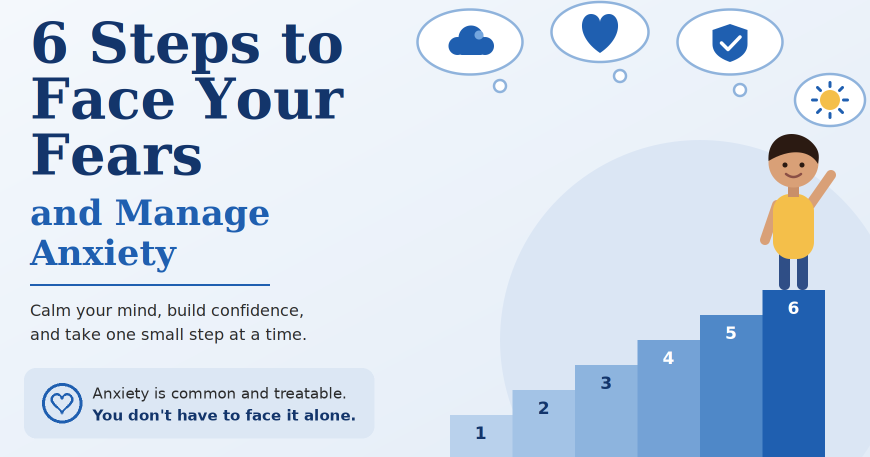
Manage Anxiety — 6 Proven Steps to Face Your Fears and Build Lasting Confidence
Learning to manage anxiety is one of the most important things a person can do for their long-term emotional wellbeing. Fear and anxiety are natural, universal human experiences — they exist to protect us, to signal that something in our environment may require attention or caution. The problem is not the presence of fear itself but when fear begins to operate beyond its protective function, generating responses that are disproportionate to the actual situation and preventing us from engaging with the parts of our lives that matter most.
If anxiety is making it harder to speak in groups, attend social events, handle professional pressure, make decisions, or simply get through ordinary days without significant distress — this blog is for you. These six steps are grounded in evidence-based psychological principles and designed to help you manage anxiety in a practical, sustainable way.
Why Avoidance Makes Anxiety Worse — Not Better
Before exploring what works, it helps to understand what does not.
When anxiety arises, the instinctive response is to avoid whatever triggered it. Avoidance works — in the short term. The discomfort reduces, the threat feels neutralised, and relief sets in. But each time we avoid something that makes us anxious, we send a message to the brain: this situation was genuinely dangerous and your fear response was appropriate. The anxiety is reinforced, not reduced. The feared situation becomes more threatening, not less.
To manage anxiety effectively, the response has to be the opposite of avoidance — and the steps below build that capacity gradually, safely, and at a sustainable pace.
Step 1 — Understand What Triggers Your Anxiety
The foundation of any effective approach to manage anxiety is self-knowledge — specifically, understanding what situations, thoughts, or environments reliably trigger your anxious response.
Mapping Your Personal Anxiety Triggers
Different people experience anxiety differently. Some feel it most acutely in social situations — meetings, gatherings, conversations with authority figures. Others experience it around performance — exams, presentations, deadlines, the possibility of making a mistake in front of others. Some people’s anxiety is diffuse and generalised, attaching to a wide range of situations without a clear focal point.
Pay attention to the moments when anxiety arises. Notice the thoughts that accompany it — what you are telling yourself about the situation, about what is likely to happen, about what it means about you. These thoughts are not facts. They are the mind’s anxious interpretations, and they can be examined and changed.
Approaching your own anxiety with curiosity rather than judgment is the first step toward being able to manage anxiety rather than being managed by it.
Step 2 — Allow Gradual Progress, Not Immediate Transformation
One of the most counterproductive beliefs about anxiety is that facing fear should be done all at once. This idea — that courage requires immediate, full confrontation — is clinically unhelpful and often makes anxiety worse.
The Case for Taking Small Steps
Gradual, incremental progress is not a lesser form of courage. It is the form that actually works. The nervous system learns through repeated, manageable experiences that a feared situation can be tolerated — not through a single overwhelming one that confirms the fear.
If public speaking makes you anxious, the path to managing that anxiety does not begin with a presentation to a large audience. It might begin with sharing a thought in a small group conversation. Then a meeting. Then a slightly larger setting. Each step builds the neurological evidence that the situation is survivable — and the anxiety reduces proportionally.
Progress is rarely linear. Some days will feel easier than others. Self-compassion through that variability is part of the process of learning to manage anxiety.
Step 3 — Challenge the Thoughts That Sustain Anxiety
Anxiety is maintained by specific thinking patterns. Learning to identify and challenge these patterns is one of the most effective ways to manage anxiety at its cognitive root.
Common Anxious Thinking Patterns
Catastrophising — assuming the worst possible outcome is the most likely one. A presentation will be a disaster. A social gathering will be humiliating. A mistake will end a career.
Overestimating threat — treating an uncertain situation as definitively dangerous before there is any evidence to support that conclusion.
Underestimating coping capacity — believing that even if the feared situation occurred, you would not be able to handle it. This belief is almost always inaccurate.
When an anxious thought arises, pause and examine it. Ask: what is the actual evidence for this? What is a more realistic assessment? What would I tell a friend who was thinking this about themselves? These questions interrupt the automatic escalation of anxious thinking and create the cognitive space needed to manage anxiety more effectively.
The goal is not forced positivity. It is honest, balanced thinking.
Step 4 — Use Gradual Exposure to Reclaim Avoided Situations
Gradual exposure is the most clinically supported method to manage anxiety related to specific feared situations. Research on exposure therapy and anxiety management outcomes consistently confirms that structured, graduated engagement with feared situations produces significant and lasting anxiety reduction — far more effectively than avoidance.
How Gradual Exposure Works in Practice
Exposure works by repeatedly demonstrating to the nervous system that the feared situation can be tolerated. The anxiety may still arise — but through repeated engagement, the intensity of the response reduces and the person’s confidence in their ability to cope increases.
The key principles are:
- Move gradually — from lower-anxiety situations toward higher-anxiety ones
- Stay in the situation long enough to allow the anxiety to peak and begin to subside naturally
- Do not use safety behaviours (checking, reassurance-seeking, distraction) that prevent full engagement
- Repeat consistently — the learning happens through repetition, not single exposures
If your anxiety disorder is severe or significantly affecting daily life, a qualified psychologist can design a personalised exposure plan and provide the clinical support needed to implement it safely.
Step 5 — Address the Physical Dimension of Anxiety
Anxiety is not only a psychological experience. It produces real, significant physical symptoms — racing heart, chest tightness, shallow breathing, muscle tension, sweating, dizziness, gastrointestinal disturbance. These sensations are the body responding to the brain’s threat signal, and they can be addressed directly.
Practical Techniques to Manage Anxiety in the Body
Box breathing — inhale for 4 counts, hold for 4, exhale for 4, hold for 4. Repeat four to five cycles. This activates the parasympathetic nervous system and directly reduces the physiological arousal of anxiety within minutes.
Progressive muscle relaxation — systematically tensing and releasing major muscle groups reduces the physical tension that anxiety generates and builds body awareness that supports better regulation.
Grounding practices — the 5-4-3-2-1 technique (name 5 things you can see, 4 you can touch, 3 you can hear, 2 you can smell, 1 you can taste) anchors attention in the present moment and interrupts the future-oriented nature of anxious thinking.
Lifestyle foundations — consistent sleep, regular physical movement, balanced nutrition, and reduction of caffeine and alcohol all directly support the body’s capacity to manage anxiety. These are not peripheral lifestyle choices — they are clinically significant components of anxiety management.
Step 6 — Seek Professional Support When Self-Directed Strategies Are Not Enough
Self-directed strategies are effective for many people — and they have genuine limits. When anxiety is significantly affecting your ability to work, maintain relationships, attend to daily responsibilities, or enjoy life, professional psychological counseling is the most appropriate and most effective next step.
What Professional Support Offers
A qualified psychologist can provide accurate assessment of your specific anxiety presentation — distinguishing between generalised anxiety, social anxiety, panic disorder, health anxiety, and other clinically distinct patterns — and developing a personalised treatment plan based on that assessment.
Cognitive Behavioural Therapy is the most extensively researched psychological treatment for anxiety and is highly effective across presentations. A psychologist can also guide the exposure process clinically, ensuring it is structured appropriately for your specific situation and that you have the support needed to sustain it.
Seeking professional help to manage anxiety is not a sign of weakness. It is the recognition that anxiety has moved beyond what self-help alone can address — and the decision to respond to that with appropriate, evidence-based care.
Managing Anxiety Is a Skill, Not a Destination
Fear does not disappear when you learn to manage anxiety well. What changes is your relationship with it. The anxious sensations arise — and you respond differently. You don’t avoid. You don’t catastrophise. You move toward the situation, tolerate the discomfort, and discover that you can handle it.
That discovery — repeated over time — is what builds lasting confidence. Not the absence of fear, but the accumulated evidence that you are capable of functioning despite it.
At Hapinus Care, our qualified psychologists support individuals across Kerala who are working to manage anxiety — through personalised, evidence-based care delivered in person at our centers in Trivandrum, Kochi, Calicut, Kannur, and Kottayam, and online in English and Malayalam.
No referral is needed. Call 9207 07 51 51 or book through WhatsApp.
